Very few teeth left in Jeju: are dentures the only option?
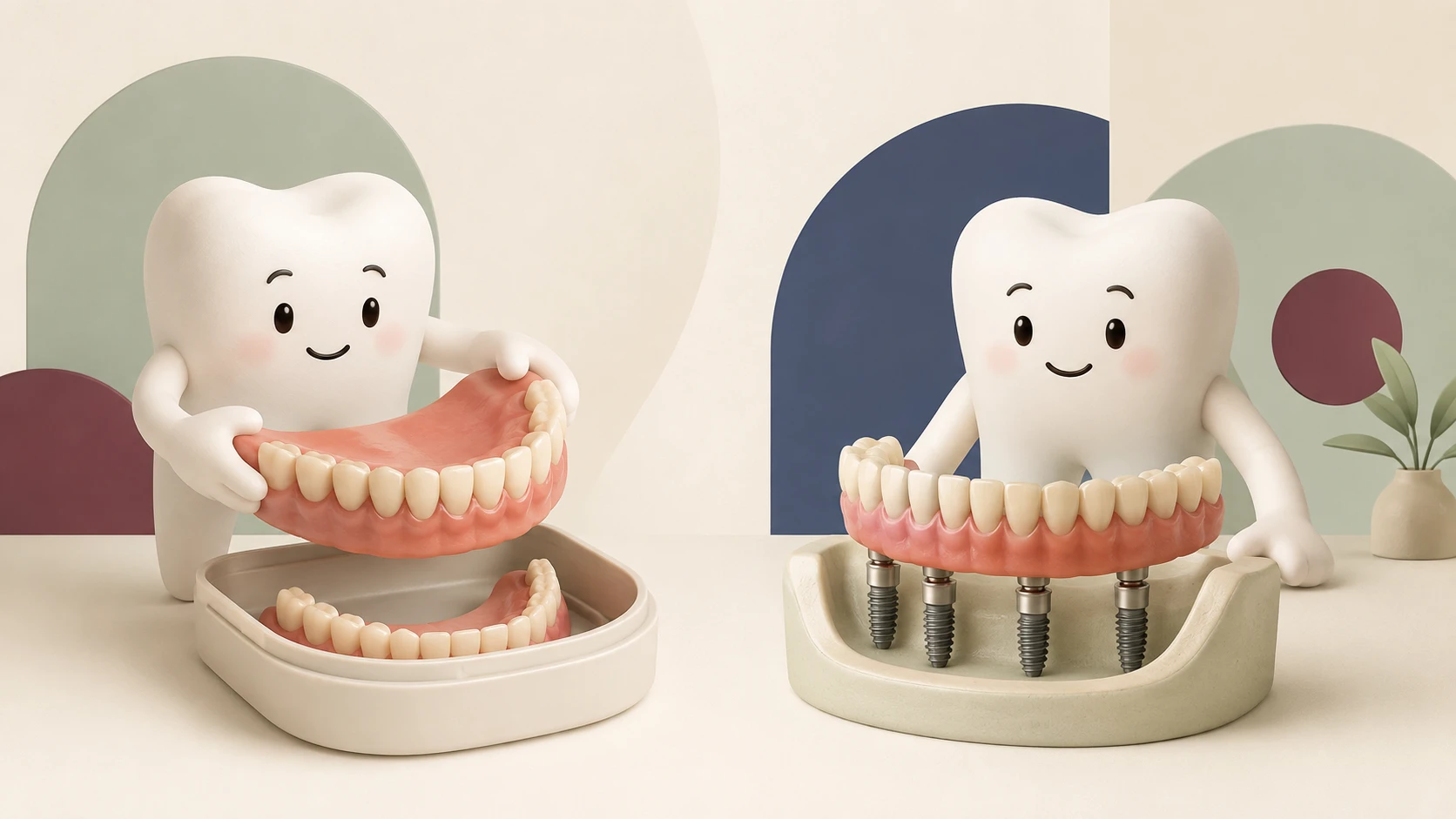
Dentures are not the only possible option when very few teeth remain.
Dr. Soohyun Ko first assesses whether remaining teeth can be used, then considers bone, medical health, eating difficulties and maintenance when discussing fixed full-arch implants.
Key points
Assess the remaining teeth before deciding on extraction. Compare dentures and fixed teeth according to your health, expectations, bone and ability to manage daily care.
Do all remaining teeth need extraction?
Not necessarily. Their future stability matters more than how many remain. Some loose teeth can be used after gum treatment, while apparently intact teeth may have deep cracks or severe gum disease.
Each remaining tooth should be assessed even when full-arch implants are being considered.
How is tooth preservation assessed?
A tooth is considered together with its supporting bone, roots, chewing forces and role in the overall treatment.
- Remaining supporting bone
- Mobility and gum disease severity
- Decay or fractures extending towards the root
- Inflammation around the root
- Direction and strength of biting forces
- Whether keeping the tooth helps the whole plan
One photograph or the degree of looseness alone cannot determine preservation. Several findings and the future outlook are considered together.
When might a digital suction denture be considered?
A denture may be a practical option when reducing surgery, medical health, bone or cost are important. It can replace extensive tooth loss without implant surgery, support lips and cheeks and be removed for cleaning.
Because it rests on the gums, it can move or press during chewing. Lower dentures can be particularly difficult to stabilise because of the tongue, cheeks and limited space.
Digital suction dentures use detailed records of oral shape and movement to improve fit and stability. Suction does not guarantee an immobile result: ridge shape, saliva and muscle movement affect it.
How do fixed full-arch implants differ?
Several implants support one connected fixed arch. An implant is not required for every missing tooth. This can be considered when removing dentures is difficult or greater chewing stability is wanted.
The jaw, bone quantity and density, opposing teeth, chewing forces, restoration design and cleaning ability determine the approach.
ITI recommends at least four appropriately distributed implants for a connected fixed complete arch. This does not mean four are best for everyone; additional implants may help depending on bone and design.
Can fixed teeth be used on the day of surgery?
Some suitable patients can receive fixed temporary teeth during healing. Initial stability, bone, grafting and the bite must be assessed during surgery, and the plan may change after placement.
This is better understood as temporary fixed teeth followed by final teeth after gum and bite stabilisation, rather than final teeth completed in one day.
How should the options be compared?
The suitable choice depends on the patient’s condition and everyday needs.
- Are any remaining teeth preservable?
- How acceptable would denture movement be?
- Can fixed teeth be cleaned effectively?
- Can health support the surgery and treatment course?
- Are regular reviews and maintenance practical?
- Which matters most: eating, stability or ease of care?
| Factor | Denture | Fixed full-arch implants |
|---|---|---|
| Attachment | Rests on gums and is removable | Connected to implants |
| Surgery | Usually no implant surgery | Implant surgery required |
| Stability | Movement depends on gums and oral conditions | Greater fixed support in suitable conditions |
| Cleaning | Removed for cleaning outside the mouth | Careful cleaning beneath the restoration |
| Maintenance | Adjustment or replacement as gums change | Regular checks of screws, teeth and implant tissues |
| Assessment | Health, ridge shape and adaptation | Bone, health, cleaning and follow-up |
What is the assessment sequence at Hyungje Dental Clinic?
Few remaining teeth do not automatically lead to extraction and full-arch implants. Photographs, X-rays, CT and scans help assess teeth and bone.
We distinguish preservable teeth from those with a poor outlook and explain the advantages, limits and care of suction dentures and fixed full-arch implants. Suitability includes health, lifestyle and maintenance, as well as technical feasibility.
What should you ask before choosing?
Ask about your findings and the reasons behind a recommendation.
- Which teeth could be preserved?
- What are the limits of dentures and fixed full-arch implants in my case?
- When will suitability for same-day temporary teeth be confirmed?
- What cleaning and regular visits will I need?
- How would a problem with part of the restoration or an implant be managed?
Understand the current condition, preservation options and likely changes from treatment before deciding.
Related articles
References
- Abou-Ayash S, et al. Clin Oral Implants Res. 2023;34(Suppl 26):177–195.
- Messias A, et al. Clin Oral Implants Res. 2023;34(Suppl 25):38–54.
- Polido WD, et al. Clin Oral Implants Res. 2018;29(Suppl 16):154–183.
This article provides general dental information. Individual diagnosis and treatment require an examination.