Why use polyethylene fibre in a composite build-up?
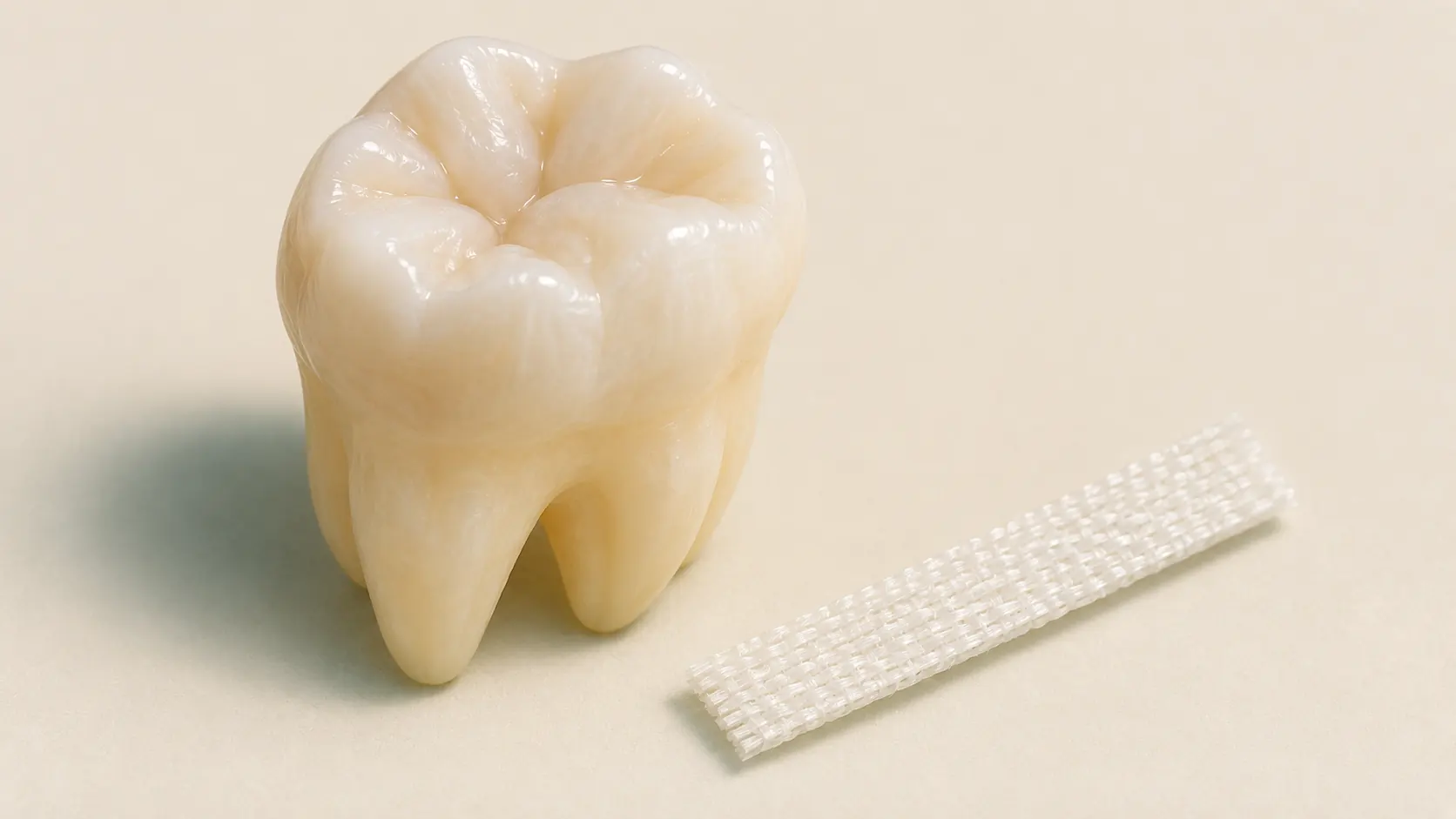
When a molar with an old filling breaks, removing the filling and decay can reveal a larger area to rebuild than expected. We first check whether the remaining tooth can withstand chewing. If a composite build-up is suitable, we may add polyethylene fibre where reinforcement is needed.
Key points
- We assess how much sound tooth remains and where chewing forces fall.
- In selected cases, a strip of woven fibre can help distribute stress within a composite build-up.
What does fibre reinforcement do?
An extensive composite restoration can put stress on the bond between the tooth and the resin. A narrow strip of woven polyethylene fibre can be embedded in the resin to help distribute that stress.
Composite shrinks slightly as it hardens under the curing light. When it is already bonded to the walls and floor of a deep cavity, that shrinkage pulls on the bond. At Hyungje Dental Clinic, we isolate the tooth with a rubber dam, place the fibre where reinforcement is needed, then cover it with composite and shape the chewing surface.
In one laboratory study on extracted molars, adding fibre to the flowable composite lining increased bond strength at the cavity floor compared with the same lining alone. The researchers suggested that the fibre may have reduced the effect of shrinkage stress. In another laboratory study, after repeated loading and temperature changes, samples with fibre were less likely to fail at the tooth–resin interface.
When do we consider fibre reinforcement?
Once the decay is removed, we check how thick the remaining walls are and how much of the chewing surface has been damaged. We also consider where chewing forces are concentrated and whether you tend to clench your teeth.
| Tooth after decay removal | Treatment approach |
|---|---|
| Small defect with substantial walls and chewing surface remaining | Rebuild the chewing surface with composite. |
| Large area to rebuild, with enough tooth structure to withstand chewing | Consider a composite build-up and reinforce where needed. |
| A large part of the chewing surface has broken away, or thin walls are at risk of fracturing | Consider an onlay or crown to protect the weakened surface. |
How the tooth responds to chewing forces
When both sides of a molar have lost a substantial amount of structure, the remaining walls may flex slightly under chewing loads. In a laboratory study that reproduced this situation, fibre-reinforced molars flexed less. A synthesis of studies on extracted teeth found that reinforced teeth generally withstood greater loads before breaking. In a separate experiment, fractures more often occurred in locations where the restoration could be repaired.
What follow-up studies found
In one study, 90 root-treated premolars and molars were rebuilt with fibre-reinforced composite. At one year, one restoration needed replacement. In a separate report, three cracked or weakened teeth were rebuilt with fibre reinforcement and then protected with an overlying restoration. At two years, the original symptoms had resolved.
A molar weakened by decay
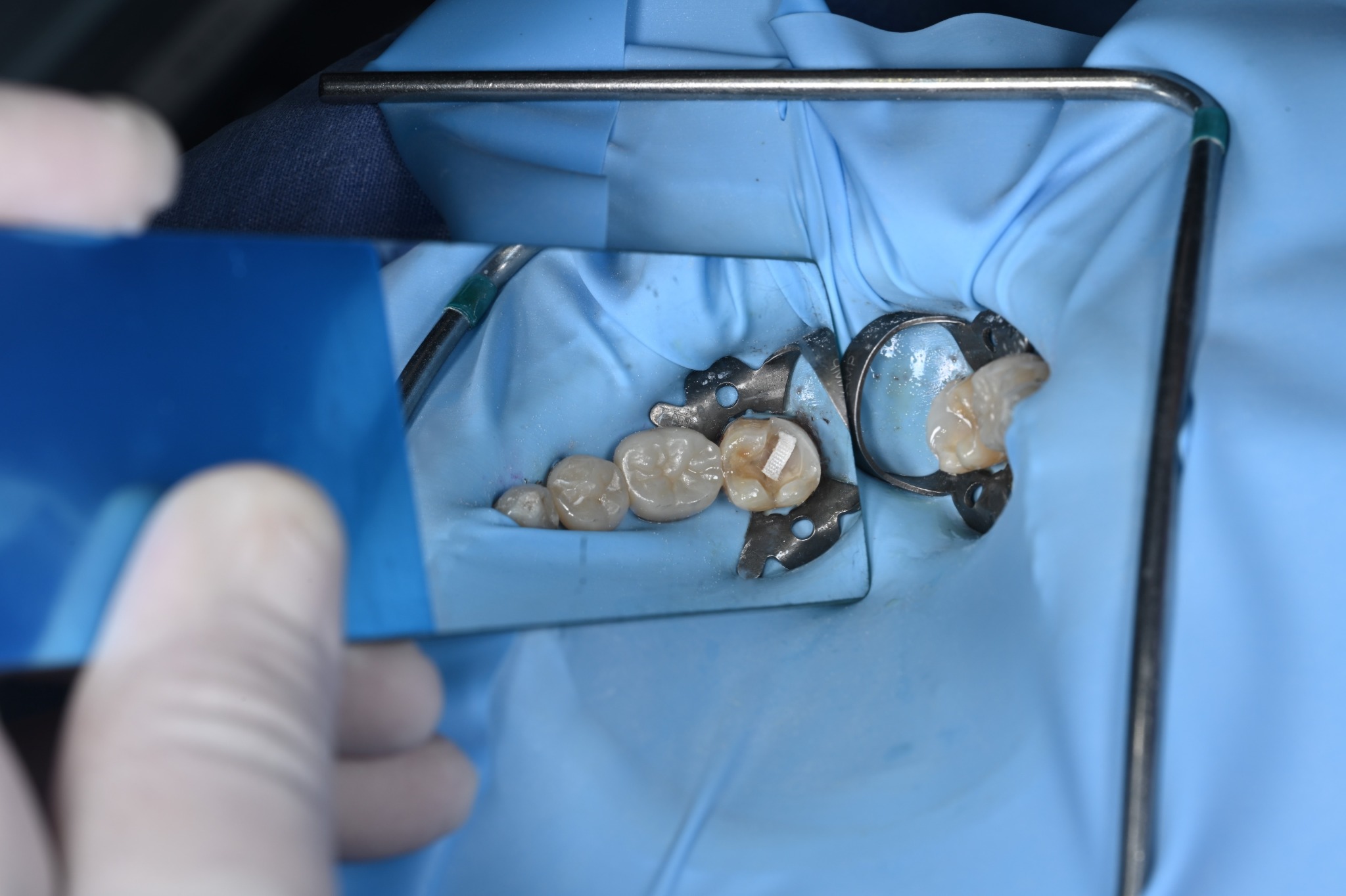
Decay had developed beneath an old amalgam filling and part of the molar had broken away. The pulp was exposed during decay removal and was treated with vital pulp therapy. After examining the remaining tooth, we reinforced it with fibre and rebuilt the chewing surface with composite. The clinical journal shows fibre placement and the tooth after treatment.
Related articles
References
- Belli et al. C-factor, fibre reinforcement and bond strength to dentine. 2006.
- Akman et al. Fibre reinforcement, cuspal movement and fracture strength in molars. 2011.
- Polyethylene fibre reinforcement and dentine bond strength after thermomechanical cycling. 2025.
- Fracture resistance of fibre-reinforced direct composite restorations: systematic review and meta-analysis of laboratory studies.
- Fracture resistance and failure patterns of fibre-reinforced molar restorations. 2026.
- Fibre-reinforced direct composite in root-treated posterior teeth: one-year clinical follow-up. 2026.
- Fibre reinforcement in cracked and weakened root-treated teeth: two-year case series. 2025.
- European Society of Endodontology. Position statement on restoring root-filled teeth. 2021.
This article provides general dental information. Individual diagnosis and treatment require an examination.