Full-mouth implants and full-arch implants: what is the difference?
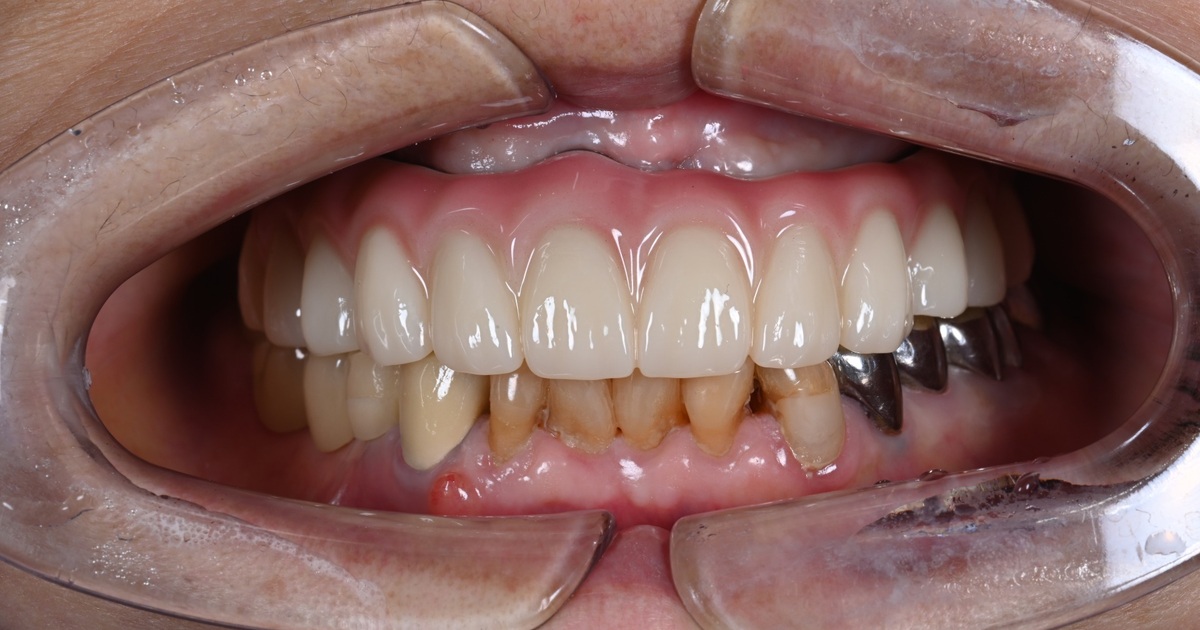
When few teeth remain, the terms “full-mouth implants” and “full-arch implants” can sound like separate treatments. Full-arch restoration is one way to replace all teeth in an arch with implants.
The useful distinction is how the replacement teeth are built: individual restorations or short bridges, versus one connected fixed prosthesis for an entire upper or lower arch. Implant placement, temporary teeth and ongoing care differ.
Key points
Full-arch restoration is one way to replace all teeth in an arch. Compare the prosthesis design, remaining teeth, bone, temporary teeth and maintenance before choosing a plan.
How do the terms differ?
“Full-mouth implants” is a broad description for replacing many teeth or a complete arch. The prostheses may be individual teeth, several shorter bridges or one connected restoration across an arch.
“Full-arch” describes an entire upper or lower arch. Hyungje Dental’s All-on-X treatment uses several implants to support a connected fixed prosthesis, so it falls within the broader category of implant treatment for all teeth in an arch.
How does the prosthesis differ?
With separate restorations or shorter bridges, a problem may be addressed in the affected section. Implant placement must support each planned restoration.
In a full-arch design, several implants support a single connected prosthesis. The restoration may also replace lost gum contour. The plan must account for load distribution and space to clean beneath it.
| What to compare | Separate restorations | Connected full-arch prosthesis |
|---|---|---|
| Structure | Individual teeth or short bridges | One fixed prosthesis spanning an arch |
| Implant placement | Support for each planned segment | Support and distribution across the entire prosthesis |
| Repair and care | Inspect the affected segment | Inspect the connection, bite and cleaning beneath the full prosthesis |
How are implant number and positions decided?
The treatment name alone does not determine the implant count. We assess available bone and its location, upper versus lower jaw anatomy, opposing teeth, space for the prosthesis and whether the finished design can be cleaned.
The number and distribution are chosen after examination and imaging. A larger count is not automatically a better result; ask why a specific plan suits your bone, bite and restoration.
See also: How many implants does a full-arch restoration need?
What happens with temporary teeth?
Neither separate restorations nor full-arch treatment necessarily proceeds straight from extraction and placement to the final prosthesis. Discuss how you will eat and what temporary teeth are possible while healing.
Whether a fixed temporary prosthesis can be attached on the day of surgery depends on initial implant stability, bone condition, the extent of treatment and the bite. Food texture and chewing force must still be managed during healing.
How do cleaning and repairs differ?
With separate restorations, the dentist can inspect a screw, prosthesis and surrounding gum in the affected segment. When a connected full-arch prosthesis has a problem, the entire connection and bite need review.
Both designs need periodic checks of the implants and prostheses. Full-arch care also requires a design that you can clean beneath, along with instruction on appropriate floss or other cleaning aids.
What should you ask at the consultation?
If any teeth might be kept, first ask which ones and why. Comparing treatment names or implant counts before reviewing the extraction plan can miss an important choice.
Bring these questions to your consultation.
- Which teeth can be preserved?
- Will the final teeth be separate restorations or one connected arch?
- Why are the proposed implant positions and number suitable for my bone and bite?
- Which temporary teeth can I use, and how should I eat during healing?
- How would a loose screw or damaged prosthesis be repaired?
- How do I clean beneath the prosthesis and how often will it be checked?
Our treatment overview and clinical journal show examples of prosthesis design and the stages of care.
Frequently asked questions
Are full-arch implants different from full-mouth implants?
A full-arch restoration is one way to replace all teeth in an arch. Ask whether your plan uses individual restorations or shorter bridges, or a single connected prosthesis.
Does full-arch treatment always use four implants?
No. The number and positions depend on the bone in the upper or lower jaw, the planned prosthesis and the bite. Your dentist should explain the proposed design after examination and imaging.
Related articles
References
This article provides general dental information. Individual diagnosis and treatment require an examination.