Full-arch implants in Jeju: are more implants always better?
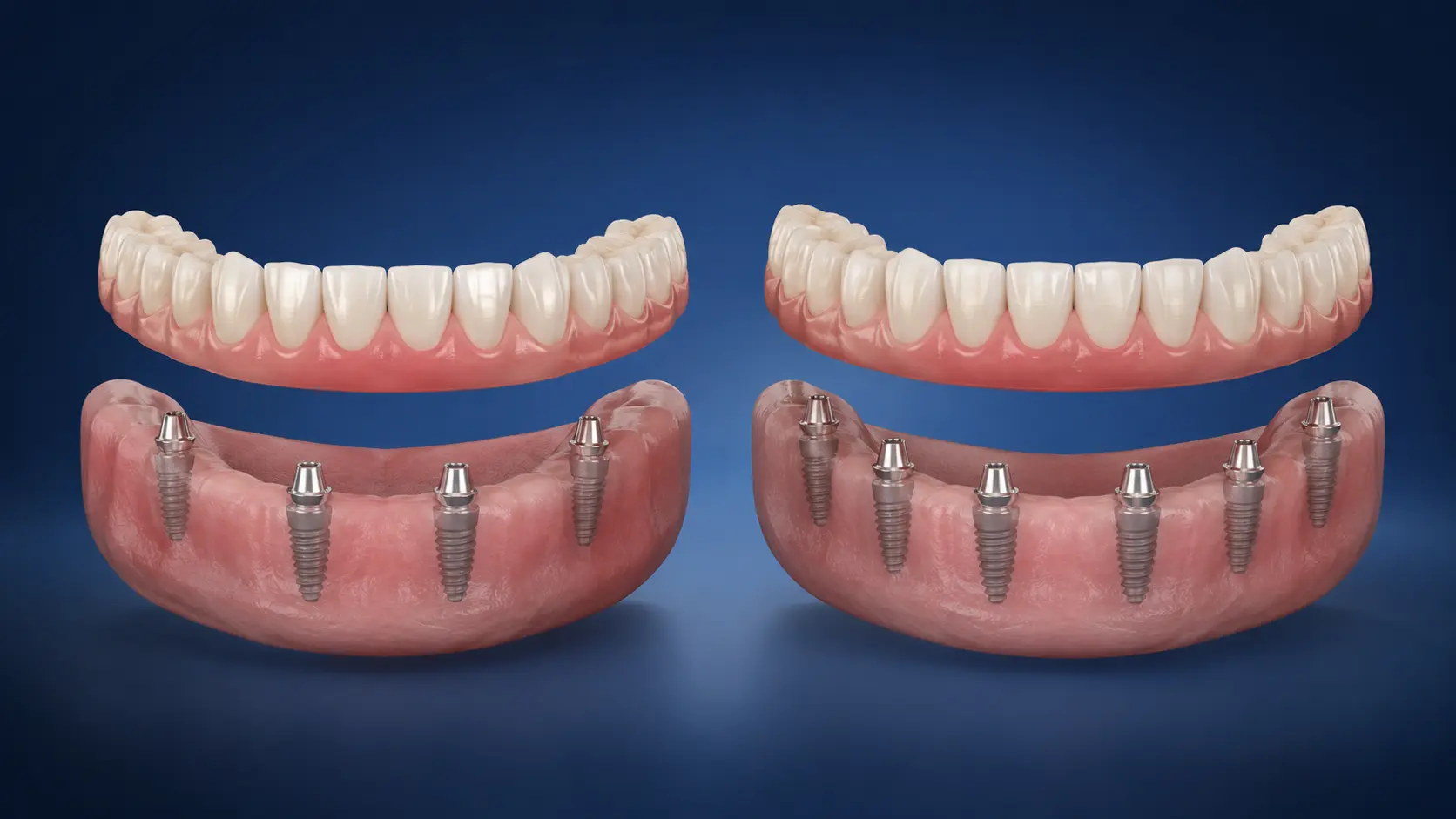
When six implants support a whole jaw, you may wonder whether that is enough. Full-arch implants use a different supporting structure from placing one implant for every tooth.
Six well-distributed implants and a connected restoration can share chewing forces. Implant anchorage and position, restoration rigidity and bite design matter alongside the number.
Key points
Six support points can provide structural stability when the available bone, implant distribution, restoration rigidity and bite are planned together. We usually consider six implants and assess four carefully in special cases with severe bone loss and limited placement sites.
Is six enough to support a whole arch?
Six does not, by itself, mean weak support. The implants and connected restoration are planned as one supporting structure. Spreading the six support points from front to back and limiting flexing of the restoration can help distribute chewing forces.
A systematic review included in the 2018 ITI consensus found no significant survival difference between fewer than five and five or more implants supporting complete fixed arches. This does not mean four are suitable for everyone.
Ask both how many implants are planned and where they will be placed and connected. Adding implants has limited benefit if support points are clustered or the restoration design is unfavourable.
Research informs the decision; individual bone, positions and restoration conditions may differ from those studied.
How do All-on-4 and All-on-6 differ?
Both connect several implants in a nearly or completely toothless jaw to fixed full-arch teeth.
All-on-4 generally uses four implants. Rear implants may be tilted to avoid anatomical structures and extend the supporting spread. All-on-6 generally uses six distributed implants, potentially adding support and design options where bone allows.
| Factor | All-on-4 | All-on-6 |
|---|---|---|
| Basic design | Four implants supporting one full arch | Six implants supporting one full arch |
| Surgery | Positions may be planned around limited bone | More sites require assessment of bone and anatomy |
| Force distribution | Front-to-back spread is particularly important | Well-positioned additional support can broaden distribution |
| Restoration | Careful planning of extensions, materials and connections | Additional support and cleaning space both need planning |
| Decision | Fewer implants do not automatically mean poorer treatment | More implants do not guarantee a better outcome |
What determines the implant number?
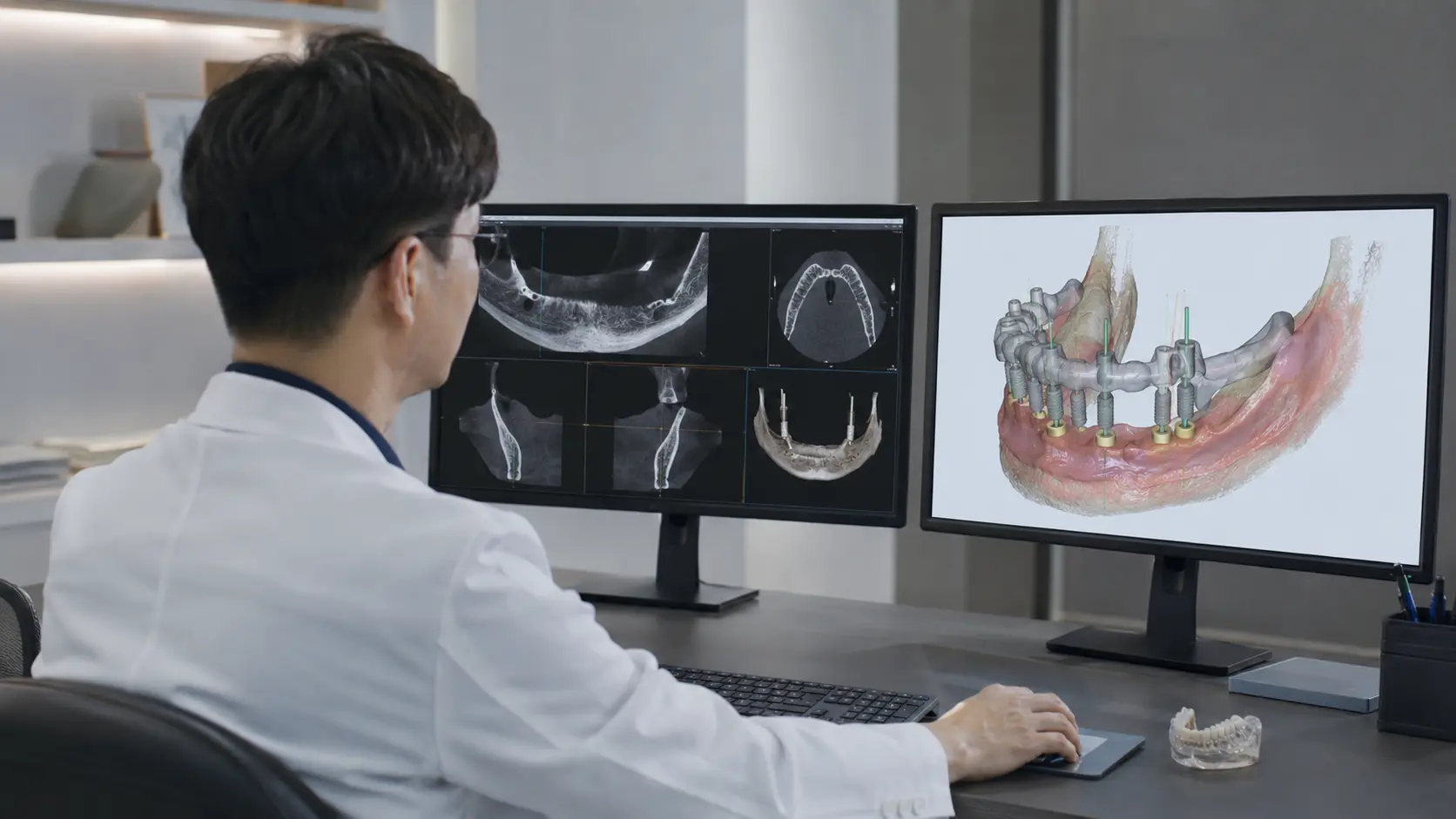
Planning works back from the final teeth rather than identifying available implant sites alone. CT, oral scans and bite records connect bone and anatomy with tooth form and loading.
- Upper or lower jaw, bone quantity and density
- Available front-to-back implant spread
- Expected initial stability of each implant
- Opposing teeth, chewing forces, grinding and clenching
- Restoration material, connections and rear extension length
- Daily cleaning and regular maintenance
- A plan for problems involving implants or the restoration
A surgical guide transfers a plan to surgery. Planning from the final teeth comes first.
Why can the upper and lower jaws need different plans?
The jaws differ in bone density and shape, available space and nearby structures. Even in one person, the same number may not be suitable for both.
Upper bone can be softer and the sinuses may limit placement. Six support points may be considered where conditions allow, but anatomy can require another design.
The front of the lower jaw can often provide useful anchorage, while the inferior alveolar nerve limits posterior positions and lengths. We assess whether six implants can be distributed appropriately or another design is needed, considering the nerve, front-to-back spread and the bite.
How can six implants provide stability and rigidity?
First, plan the support positions. Each implant needs adequate anchorage in the remaining bone, with an appropriate front-to-back spread. The length of any restoration extending behind the last implant—the cantilever—also needs control.
Second, plan the restoration’s rigidity: its resistance to bending under chewing forces. Material, thickness and connection shape are considered together. A metal bar may reinforce the structure where needed; the overall design and fit to the implants matter.
Third, manage chewing forces. Contacts with opposing teeth, clenching and grinding, and restoration length must be assessed. Implant distribution, restoration rigidity and the bite need to work together.
When are four implants considered?
Four implants may be considered when prolonged denture use and severe bone loss make posterior placement difficult.
Supporting a whole arch with four implants in limited bone requires high accuracy in both surgery and restoration fabrication. This is a demanding treatment choice.
How does Hyungje Dental Clinic decide?
We assess which teeth can be retained and plan the final tooth positions using CT and oral scans before deciding the implant number.
We usually consider six support points for full-arch treatment. In special cases with severe bone loss and limited placement sites, the dentist’s experience and assessment guide whether four implants can provide adequate anchorage and support. The plan also accounts for the restoration structure and bite.
The result needs to allow cleaning, examination and investigation of problems with screws, the restoration or implants.
Frequently asked questions
Do four implants have a shorter lifespan than six?
Number alone cannot predict lifespan. Position, distribution, bone stability, the bite, design, hygiene and reviews all contribute.
If there is enough bone, is six always better?
No. Extra implants should occupy positions that improve support or the restoration design.
What happens if one of four implants develops a problem?
The response depends on the cause, position, other implants and restoration. The dentist may remove the restoration to assess revision surgery, modification or a new design.
Does advanced age mean only All-on-4 is possible?
Age alone does not determine the number. Medical health, medication, bone, cleaning and follow-up are assessed together.
Can I use teeth on the day of All-on-4 or All-on-6 surgery?
Some patients can receive fixed temporary teeth if suitable conditions and initial stability are confirmed during surgery.
Related articles
References
- Polido WD, Aghaloo T, Emmett TW, Taylor TD, Morton D. Number of implants placed for complete-arch fixed prostheses: A systematic review and meta-analysis. Clin Oral Implants Res. 2018;29(Suppl 16):154–183.
- Toia M, et al. Fixed Full-Arch Maxillary Prostheses Supported by Four Versus Six Implants: 5-Year Results of a Multicenter Randomized Clinical Trial. Clin Oral Implants Res. 2025;36(3):298–313.
- Tallarico M, Meloni SM, Canullo L, Caneva M, Polizzi G. Five-Year Results of a Randomized Controlled Trial Comparing Maxillary Fixed Prostheses Supported by Four or Six Implants. Clin Implant Dent Relat Res. 2016;18(5):965–972.
This article provides general dental information. Individual diagnosis and treatment require an examination.