Dentures or full-arch implants for your parents in Jeju: what should you consider?

When parents have very few teeth or struggle to eat with dentures, families often ask which treatment is better.
At Hyungje Dental Clinic in Seogwipo, Dr. Soohyun Ko first assesses remaining teeth, bone, inflammation, medical conditions and medication. The bite, daily cleaning and practical follow-up help determine which options fit the parent’s life.
Key points
Begin with the remaining teeth and the difficulties experienced during meals. Compare removable and fixed options alongside medical health, recovery and everyday care.
What changes should families look for?
A parent may dismiss dental discomfort as part of ageing. Ask about changes in meals and daily life as well as pain.
- Sore or ulcerated gums, or dentures moving during speech or chewing
- Avoiding meat and vegetables and preferring porridge or food softened in soup
- Longer meals or eating less
- Loose or painful teeth or recurring gum swelling
- Chewing only with front teeth or on one side
- Removing dentures to eat or wearing them only outside
- Avoiding conversations or gatherings because of breath, trapped food or speech changes
These are reasons to assess the effect of teeth and dentures on daily life. They do not automatically mean extraction or full-arch implants are needed.
Why assess remaining teeth before choosing treatment?
Planning starts with each tooth’s prospects for preservation rather than a decision to remove everything.
We examine movement, bone quantity and shape, decay, fractures, inflammation, denture fit and the bite. Medical health, the final tooth design, cleaning and regular maintenance also affect the choice.
It may be appropriate to keep treatable teeth and remove those with a poor outlook. If repeated treatment is unlikely to resolve pain and loss of function, a wider treatment plan may be considered.
How do dentures and fixed full-arch implants compare?
Conventional and suction dentures are removed and inserted by the patient. Suction dentures use detailed records of the gums and surrounding muscle movements, but their suitability and retention depend on the mouth.
Hyungje Dental Clinic’s full-arch implants support fixed teeth. Their use and cleaning differ from removable dentures. Same-day fixed temporary teeth depend on bone, surgery, initial implant stability and the bite. If these conditions are unsuitable, another temporary option or staged treatment may be needed.
- Can the patient clean beneath the fixed teeth?
- Can a caregiver help with limited hand strength or vision?
- Are regular dental visits practical?
- Can the restoration, screws and surrounding tissues be checked over time?
| Factor | Conventional denture | Digital suction denture | Fixed full-arch implants |
|---|---|---|---|
| Use | Removed and inserted daily | Removed and inserted daily | Fixed to implants; not removed by the patient |
| Surgical burden | Usually limited | Usually limited | Implant surgery and healing required |
| Adaptation and stability | Movement or bulk may depend on gums and bone | Retention may improve in suitable oral conditions | Healing and adaptation to bite and speech are needed |
| Daily care | Remove to clean the denture and gums | Remove to clean the denture and gums | Clean underneath and around implants with suitable aids |
| Key assessment | Ability to remove and clean it | Oral conditions suitable for suction | Medical health, surgery, cleaning and follow-up |
Digital suction dentures are a way of recording and making dentures to improve retention and stability. They do not produce the same suction in every patient.
Can someone in their eighties receive full-arch implants?
Age alone does not decide. Health, activity, medication and recovery differ widely. We review disease control, medication history, recent admission or surgery, tolerance of longer appointments and postoperative cleaning.
- Anticoagulants or antiplatelet drugs used to prevent clots
- Osteoporosis drug name, route and duration
- Diabetes control and recent results
- Heart or cerebrovascular disease and recent surgery or admission
- Kidney or immune conditions and cancer treatment
- Smoking and ability to brush
Family members must not stop prescribed medication themselves. When needed, the dentist coordinates treatment timing and scope with the prescribing clinician.
How can family members help?
A caregiver can help organise explanations when the parent finds them hard to remember or receives different plans. Support continues through recovery and long-term care.
- Consultation: clarify the main difficulties, treatment scope, duration, visits and alternatives
- Decision: ask why teeth should be preserved or removed, as well as the implant number
- Recovery: organise medication and appointments and help with suitable meals and cleaning
- Long-term care: learn denture or fixed-restoration cleaning together and organise reviews
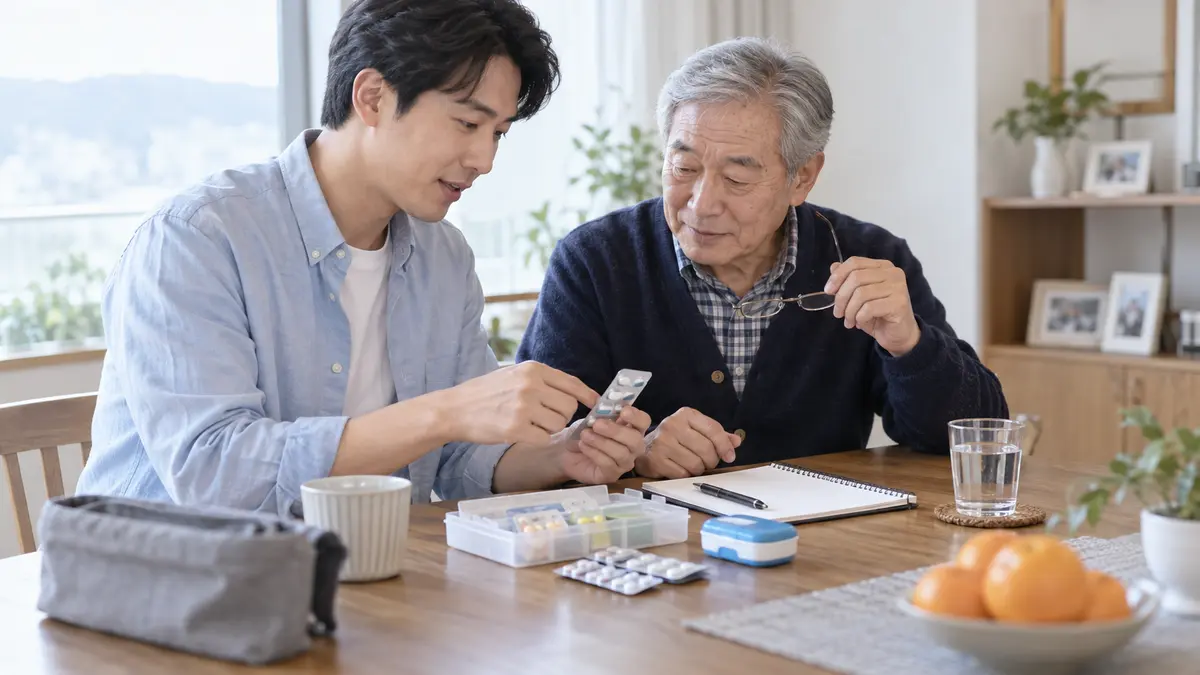
What should you bring to the first consultation?
Families arranging care in Jeju can prepare the following information on one page.
- Diagnosed medical conditions and treating hospitals
- Medication names and doses, prescriptions or packaging photographs
- Osteoporosis drug names, administration dates and duration
- Recent admissions, surgery, stroke or heart attack
- Previous dental treatment and difficult experiences
- Current dentures and when they were made
- Location of pain, movement or gum sores
- Avoided foods and changes in appetite or meal size
- Ability to brush and clean dentures independently
- Available help with appointments and regular reviews
Bring current dentures even if they no longer fit. Wear, the bite and the sites of discomfort provide useful information.
Frequently asked questions
Should all remaining teeth be removed if very few remain?
No. Each tooth is assessed for movement, bone support, decay, fracture and inflammation before its outlook is judged.
Are fixed full-arch implants possible in the eighties?
Suitability depends on disease control, medication, bone, recovery, appointment tolerance and cleaning. Same-day temporary teeth require appropriate findings and initial implant stability.
Should a painful, moving denture be replaced by another treatment?
The denture, teeth, bone and bite should first be examined, including options for adjustment, repair or replacement. Persistent discomfort may justify comparing dentures, suction dentures and fixed full-arch implants, but discomfort alone does not establish the need for implants.
What if we do not know the medication names?
Bring prescriptions, packaging, medication guides or photographs. Names and duration are particularly important for blood-thinning and osteoporosis drugs. Do not stop them yourself.
Can a child ask about treatment before the parent attends?
General options and preparation can be discussed, but a treatment plan requires the parent’s examination, imaging and medical assessment. Attend together if possible.
Related articles
References
- Schimmel M, et al. Effect of advanced age and/or systemic medical conditions on dental implant survival: A systematic review and meta-analysis. Clin Oral Implants Res. 2018;29 Suppl 16:311–330.
- Stanford CM. Dental implants. A role in geriatric dentistry? J Am Dent Assoc. 2007;138 Suppl:34S–40S.
- Ruggiero SL, et al. American Association of Oral and Maxillofacial Surgeons' Position Paper on Medication-Related Osteonecrosis of the Jaws—2022 Update. J Oral Maxillofac Surg. 2022;80(5):920–943.
This article provides general dental information. Individual diagnosis and treatment require an examination.