A premolar treated with resin build-up instead of a crown in Jeju
Deep decay in tooth 15 was treated with vital pulp therapy, fibre reinforcement and resin build-up to preserve remaining tooth.
Treatment at a glance
- Initial findings
- Decay affected both surfaces of a premolar that touched neighbouring teeth, and the chewing surface also needed restoration.
- Treatment plan
- We chose vital pulp therapy and resin build-up to preserve the pulp and sound remaining tooth.
- Treatment
- Vital pulp therapy, fibre reinforcement and resin build-up were performed under rubber-dam isolation.
- After treatment
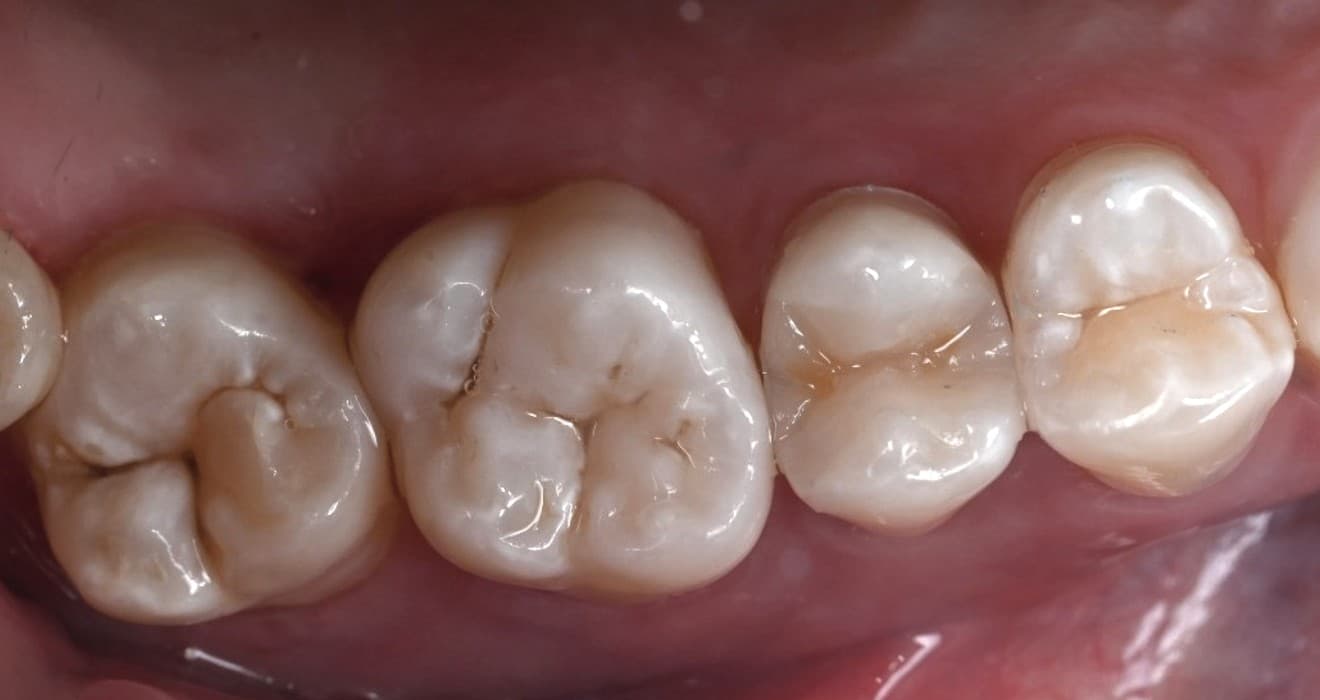
- Photographs documented the resin restoration from the contacts with neighbouring teeth to the chewing surface.
Why treat decay that was hard to see?
The initial photograph did not show a large open cavity. The decay was at the contacts with neighbouring teeth, where a view from above could not show the full internal condition.

What the X-ray showed
A dark area extended inward from the side of the premolar. This was the area damaged by decay that required treatment.

Damage at both contacts
During treatment, damage on both sides became visible. The chewing surface and both contacts with neighbouring teeth needed restoration.

Preserving sound tooth and the vital pulp
A crown would require additional preparation to provide room for the restoration. To make use of the remaining tooth, vital pulp therapy was followed by resin build-up.
Vital pulp therapy aims to preserve living pulp inside the tooth. Treatment and protection are selected according to its condition, followed by sealing and restoration of tooth form.

Reinforcing the wider restoration
The white strip in the photograph is fibre placed within the resin. In a restoration involving both side surfaces and the chewing surface, it may help distribute forces and limit crack propagation.
The blue rubber dam isolates the area from saliva. After establishing the bonding environment, fibre and resin were used to rebuild the tooth.

Completing the resin build-up
Resin restored the neighbouring contacts and chewing surface. Considering natural tooth structure and its response to forces while preserving remaining tooth is part of the biomimetic approach.
The amount and condition of sound tooth determine treatment. Some teeth need a crown or root canal treatment; fibre reinforcement does not eliminate fracture risk, and follow-up remains necessary.

Read more
- Can a large cavity be treated with resin build-up instead of a crown? — Jeju
- How can a tooth restored with resin build-up last longer? — Seogwipo, Jeju
- Does decay around an old inlay mean you need a crown? — Jeju
- Biomimetic resin treatment and tooth preservation
- Why fibre reinforcement is used with resin (Korean blog)
References
- American Association of Endodontists. Position Statement on Vital Pulp Therapy. 2021.
- Fibre placement and fracture resistance in premolar MOD restorations. 2022. Laboratory study using extracted teeth; this does not directly establish long-term clinical survival.
- Academy of Biomimetic Dentistry. The Biomimetic Approach.
This clinical journal describes an actual treatment case with identifying information excluded.
Treatment methods, duration, and outcomes may vary according to general health, oral condition, bone, bite, and maintenance needs.
This page provides general medical information and does not replace an individual examination or diagnosis.